
When Do You Need a Dental Implant? Signs and Alternatives
An implant makes sense when a tooth is missing or must come out and you want a fixed tooth without touching the neighbors. Signs, alternatives, when to wait.
Written by the team of Dr. Jesara López · Dental Surgeon (UABC) · Mexicali, B.C.
Updated:
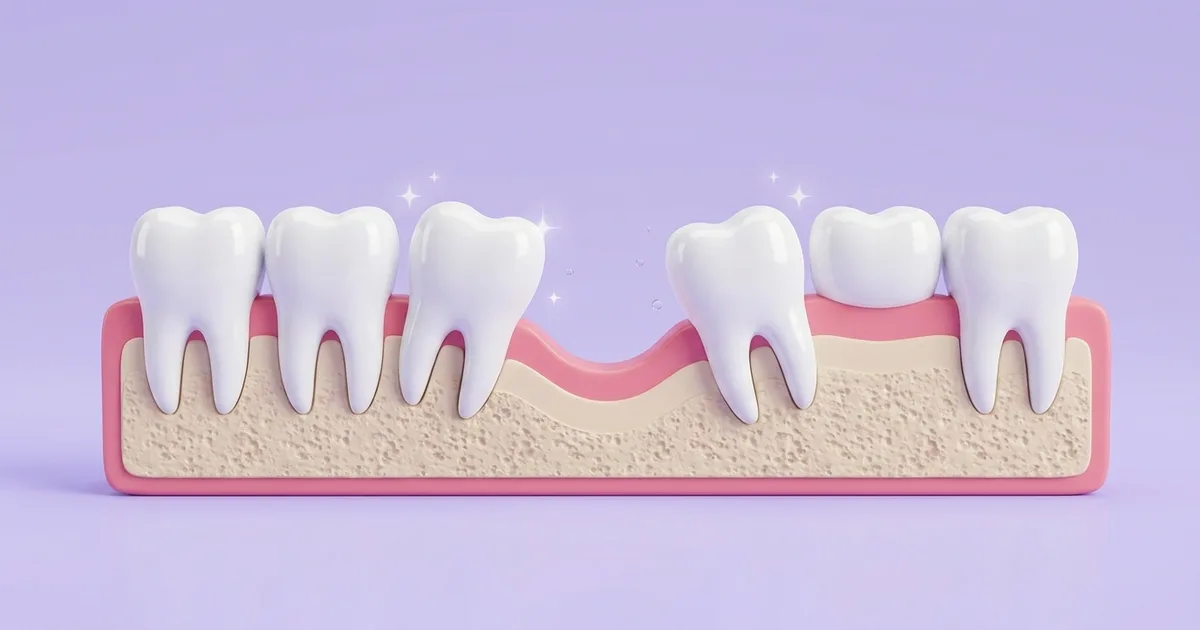
You should consider a dental implant when a tooth is missing, or has to come out, and you want to replace it with something fixed that does not rely on the teeth next to it. The implant replaces the root; a crown goes on top that looks and works like your own tooth. It is not the only option — a fixed bridge and a removable partial denture also exist — and it is not always the best choice for everyone. It depends on your bone, your health, and the condition of your neighboring teeth.
What an implant is (and what it is not)
An implant is a titanium post placed inside the jawbone, where the root of the tooth used to be. Over the following months the bone bonds to it — a process called osseointegration — and then the final crown can be attached.
Two things patients often get wrong:
- The implant is not the final tooth. It is the root. The crown goes on 3 to 6 months later, once the implant has fused with the bone.
- It is not a one-day procedure. Expect several visits over those months: exam, surgery, check-ups and crown placement. If you live in the US, plan for several trips across the border — we explain how in dental implants in Mexicali from the US.
Signs an implant may be right for you
1. You have a gap and it bothers you
Maybe it shows when you smile, maybe it is a back tooth and chewing is harder, or maybe you have noticed the teeth beside the gap starting to tilt. When a root is gone, the bone in that spot slowly shrinks. An implant is the only option that puts a root back in that place.
2. You were told a tooth cannot be saved
A cracked root, decay that went too deep, or a tooth that already had a root canal and failed again. If the extraction cannot be avoided, it pays to plan the implant from that moment. Sometimes the implant can go in the same day the tooth comes out (an immediate implant); other times the socket is preserved so the implant can be placed later. Our tooth extraction aftercare guide explains the first days after the extraction.
3. Your partial denture moves or hurts
Many people get tired of clasps, adhesive, or a denture that shifts while eating. Implants can anchor a fixed bridge or make a denture much more stable. We compare all three options in implant vs. bridge vs. denture.
4. The teeth next to the gap are healthy
A fixed bridge needs the two neighboring teeth to be ground down so it can rest on them. If those teeth are healthy, an implant replaces the missing one without touching them.
When an implant may NOT be the best option (for now)
- You smoke and cannot stop while it heals. Tobacco is the main cause of implant failure.
- You have an active infection or untreated gum disease. That gets treated first; the implant is planned afterward.
- There is not enough bone. Often this is solved with a bone graft in the same office, but it adds time.
- Uncontrolled health conditions (for example, poorly controlled diabetes) or treatments that affect healing. Each case is reviewed individually.
- You want no surgery or need a quick fix. A bridge or a removable denture takes fewer visits.
- The neighboring teeth already need crowns. Then a bridge can solve both problems at once.
Not being a candidate today does not mean never — sometimes treating your gums or quitting smoking for a few months is enough.
The alternatives at a glance
| Implant | Fixed bridge | Removable denture | |
|---|---|---|---|
| Surgery? | Yes | No | No |
| Touches neighboring teeth? | No | Yes, they are ground down | Rests on them with clasps |
| Fixed? | Yes | Yes | No, it comes out |
| Timeline | 3 to 6 months | Fewer visits | Fastest option |
See our price list for each option; the implant-plus-crown figure is in the Quick facts above.
How the decision is made at your exam
No one should place an implant without examining you first. At your evaluation we look at:
- How much bone you have where the implant would go, and whether you need a graft.
- Your gums and the teeth on either side.
- Your general health and the medications you take.
- Your bite and your goals — looks, chewing, comfort.
With that, the doctor tells you whether an implant is a good fit, what the alternatives are and what your treatment would involve.
At our office in Mexicali
- Implants are placed by Dr. Fidel Machado, a specialist in implantology and prosthodontics. Because he is also a prosthodontist, he plans the final tooth from day one. He sees patients mostly on Saturdays, so you can plan your visits without missing work.
- A periodontist, a prosthodontist and oral surgeons work in the same office for complex cases.
- After your exam we send you a written treatment plan by WhatsApp, with the implant, the crown and any graft listed separately with their cost. Nothing is done until you approve it.
- We are about 3 miles from the Calexico West border crossing. You can pay in US dollars, cash or card, and our front desk answers in English on WhatsApp.
- After surgery you get our dental implant aftercare guide in English on your phone, and later the implant prosthesis care guide.
Questions about your case? Send us a photo or your X-ray on WhatsApp and we will point you in the right direction before you book. See how we work in dental implants in Mexicali.
Frequently asked questions
My dentist in the US says I need an implant. Can I get a second opinion in Mexicali?
Yes. Send us your X-rays or your treatment plan by WhatsApp and we can tell you what we would need to see. At your exam in Mexicali you get your own written plan, with each step and its cost listed separately.
Is it urgent to get an implant right after a tooth is pulled?
It is not an emergency, but waiting years is not ideal: without a root, the bone in that area slowly shrinks and the neighboring teeth can drift into the gap. It is best to plan the implant when the tooth comes out; sometimes we preserve the socket to protect the bone for the implant.
Can I get an implant if I have diabetes or smoke?
Smoking is the main reason implants fail, so you need to stop while it heals. With diabetes or other conditions we look at each case; what matters most is that they are under control. Tell us your medical history at your exam.
I am missing several teeth. Do I need one implant per tooth?
Not always. Several teeth in a row can be replaced with a bridge on two implants, and a full arch with a fixed bridge on several implants (USD 4,000–5,500 per arch). The doctor decides based on your bone.
How much is the implant by itself?
The titanium implant is USD 800 and the crown on top is USD 500–600. If you need a bone graft, add USD 200. You get your exact cost in writing after your exam.