
Dental Sealants for Kids: Are They Worth It and How Long Do They Last?
Sealants cover the grooves of healthy molars, where most kids' cavities start. How they're placed, how long they last, what they don't do and when to check.
Written by the team of Dr. Jesara López · Dental Surgeon (UABC) · Mexicali, B.C.
Updated:
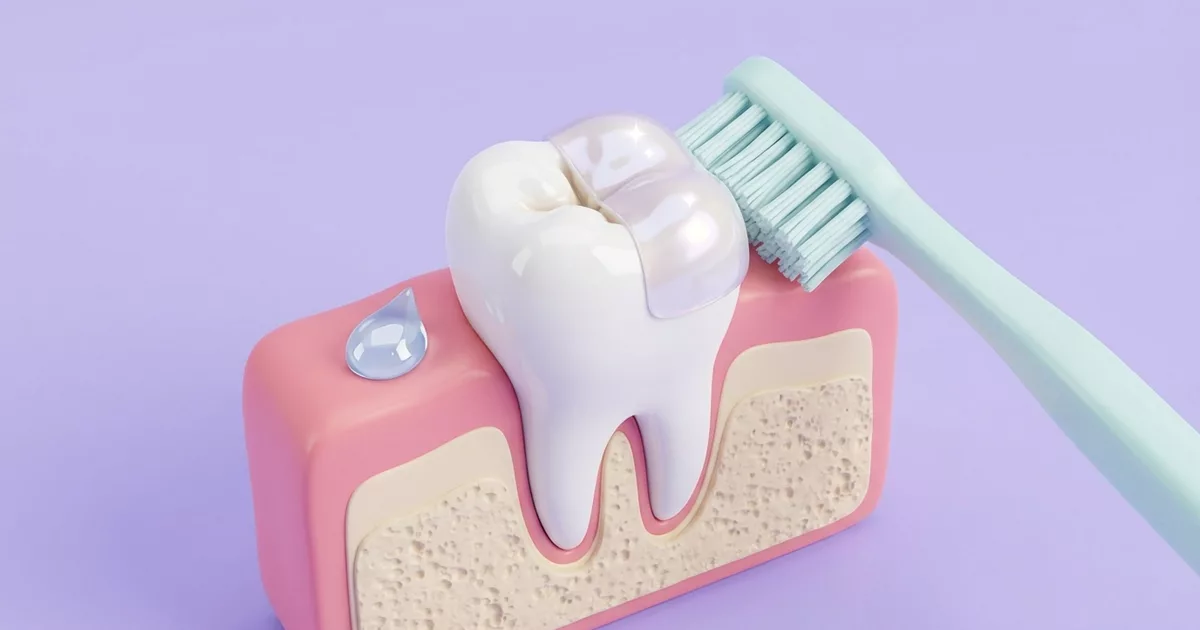
For most kids, yes: dental sealants are worth it. A sealant is a thin coating over the pits and grooves on top of the back teeth, exactly where food gets trapped and a toothbrush has a hard time reaching. It goes on healthy molars, without pain and usually without a shot, and we check it every 6 months. Sealants don’t replace brushing and don’t protect between the teeth, but they guard the part of the tooth where most children’s cavities begin.
What a sealant actually is
The chewing surface of a molar has tiny pits and grooves. In many children they’re so deep that toothbrush bristles can’t get all the way in. Plaque builds up there every day, and that’s where the first cavity usually starts.
A sealant is a liquid material that’s painted into those grooves and hardened in seconds with a blue light. It leaves a smooth surface that “closes” the grooves so food and bacteria can’t settle inside. There’s no drilling: the tooth stays the same, just protected.
When kids get them
Sealants go on permanent molars, as soon as they’re fully in and while they’re still healthy:
- Around age 6, when the first permanent molars come in behind the baby molars.
- Around age 12, when the second permanent molars come in.
Every child is different, which is why a check-up every 6 months matters: our pediatric dentist can seal each molar once it has fully come in and before a cavity shows up. If your child is past those ages, it’s still worth asking. What matters is that the tooth is healthy.
What about baby teeth?
Sealants are mainly used on permanent molars, because those are the teeth your child keeps for life. For some kids whose baby molars have very deep grooves, or who have had several cavities already, our pediatric dentist may suggest sealing a baby molar too. It isn’t the rule: it depends on your child’s teeth and cavity risk, and we look at it during the exam. If we recommend it, it shows up on the written plan with its cost, and you decide.
How they’re placed
For most kids this is one of the easiest visits:
- The tooth is cleaned.
- It’s kept dry for a few minutes with cotton rolls.
- A gel prepares the surface and is rinsed off.
- The sealant is painted into the grooves.
- A blue light hardens it, a few seconds per tooth.
- We check the bite so nothing feels high.
No needles and no drill. The hardest part for some kids is keeping their mouth open for a while, so our pediatric dentists work at your child’s pace, with breaks and explaining each step. If your child is nervous, see what to do if your child is afraid of the dentist.
How long they last, and why we check them
A sealant can last several years, but not forever. Everyday chewing slowly wears it down, and sometimes a piece chips off. A sealant with a gap lets plaque back in.
At every 6-month check-up, our pediatric dentist:
- Makes sure each sealant is still complete.
- Touches up any part that has worn away.
- Looks for cavities anywhere else in the mouth.
That check-up usually lines up with your child’s cleaning, so there’s no need for an extra appointment. Home care tips are in our kids’ dental cleaning guide.
What sealants don’t do
Good to know, so nobody gets too relaxed:
- They don’t replace brushing. Your child still needs to brush twice a day with fluoride toothpaste, with your help if they’re young.
- They don’t protect between the teeth. Cavities that start between molars, where floss goes, aren’t prevented by sealants.
- They don’t fix a cavity. A tooth with decay is treated first; sealants are for healthy teeth.
- They don’t make sugar harmless. Frequent snacks and sugary drinks still damage teeth, sealants or not.
Think of a sealant as a raincoat for the most exposed part of the tooth: it helps a lot, but it doesn’t replace the rest of the routine.
Aftercare
Sealants need almost no special care. Your child can eat and drink normally after the visit. We do suggest:
- Avoid chewing ice, hard candy or pencils.
- Keep brushing and flossing as usual.
- Let us know if something feels rough or high.
- Come back for the 6-month check.
After the visit, our dental sealants aftercare guide arrives on WhatsApp, in English.
Coming from Calexico or the Imperial Valley
About one in four of our pediatric appointments in 2026 were for families with a U.S. phone number. A sealant visit is short and predictable, which makes it easy to plan around a crossing:
- Message us first. Our front desk replies in English on WhatsApp at +52 686 203 1211, the same number from the U.S.
- Combine visits. Sealants can often be done on the same trip as a check-up or cleaning if the teeth are healthy.
- Saturdays work. We’re open Saturday 9 am to 3 pm, Pacific Time, the same as Calexico.
- We’re close. About 3 miles from the downtown border crossing (Calexico West).
If a cavity turns up in a baby tooth, we explain why it’s still worth treating in cavities in baby teeth.
At our office in Mexicali
Sealants are placed by our pediatric dentists, Dr. Alicia Ojeda and Dr. Nashla Ruiz, in 60-minute appointments. In 2026 most of the children we saw were 6 to 9 years old, right when the first permanent molars come in.
Before anything is done, you get a written plan on WhatsApp showing which teeth we recommend sealing and the cost of each, and nothing happens until you approve it. You can pay in U.S. dollars (cash or card), pesos, cards or transfer. Prices for all children’s treatments are on our price page, and how much a pediatric dentist costs in Mexicali explains what changes the total. See everything we do on our pediatric dentist in Mexicali page.
Frequently asked questions
Can a sealant go on a tooth that already has a cavity?
Not as a treatment. Sealants are for healthy teeth. If our pediatric dentist finds a cavity, it's treated first, usually with a kids' filling ($900 MXN (≈ USD 55)), and the molars that are still healthy can be sealed.
Will people be able to see them?
Hardly. Sealants are clear, white or tooth-colored and sit on the chewing surface of the back teeth, so they don't show when your child smiles.
Can my child eat right after?
Yes. The sealant is hard before you leave. As always, it's best to avoid chewing ice or very hard candy, which can chip it.
What if a sealant comes off?
The tooth is simply back to how it was, without the extra protection. It doesn't hurt and it isn't an emergency. We check it at the next 6-month visit and redo that part if needed.
Can we do sealants on the same trip as a cleaning?
Often, yes, if there's room in the schedule and the teeth are healthy. Message us on WhatsApp before you cross and we'll plan the visit so you make as few trips as possible.