
What Age Should Kids Get Braces? Early Orthopedics vs Braces
When early orthopedic treatment makes sense, when braces do, the signs your child needs an evaluation, and who decides the right time. A guide for parents.
Written by the team of Dr. Jesara López · Dental Surgeon (UABC) · Mexicali, B.C.
Updated:
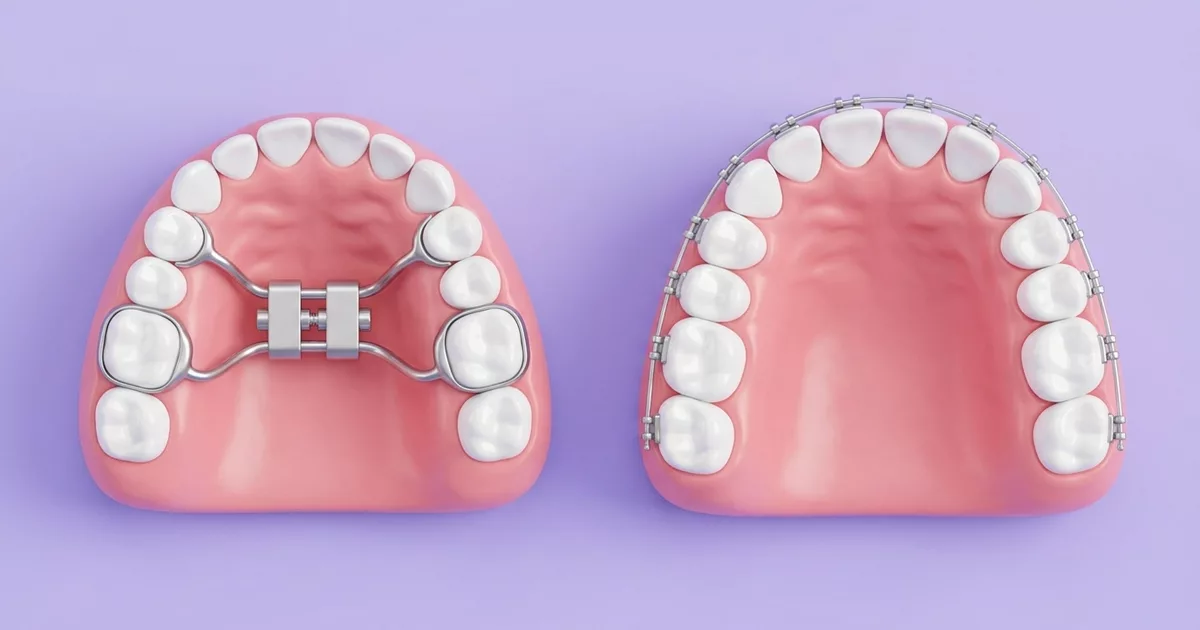
There’s no single right age for braces: it depends on how your child’s teeth and jaws are developing. Braces generally go on once most permanent teeth have come in. Before that, while baby teeth are still there, the usual tool is early orthopedic treatment: appliances such as expanders or space maintainers that use growth to guide it. The best way to know what your child needs, and when, is an evaluation with an orthodontist. If you notice any of the signs below, don’t wait for “all the adult teeth to come in.”
Orthopedics and orthodontics aren’t the same thing
They sound alike, but they correct different things:
| Early orthopedics | Orthodontics (braces) | |
|---|---|---|
| What it corrects | Bone growth: width of the palate, how the upper and lower jaws meet | The position of the teeth |
| When | While the child is growing and still has baby teeth | Generally once most permanent teeth are in |
| Appliances | Expanders, space maintainers, functional appliances | Braces or aligners, plus a retainer at the end |
| Advantage | Uses growth that won’t be there later | Places each tooth precisely |
Often they’re stages on the same path: orthopedics first to make room or correct the bite, braces later to fine-tune tooth position. Other times one is enough, or neither is needed.
Signs your child should be evaluated
It’s worth having an orthodontist take a look if you notice:
- Crossbite: some upper teeth bite inside the lower ones.
- Crowding: permanent teeth coming in overlapped or behind baby teeth.
- Baby teeth lost very early, from a cavity or an injury, before the adult tooth is ready.
- Habits that continue past the early years, like thumb-sucking or long-term pacifier use.
- Regular mouth breathing or heavy snoring.
- A jaw that looks too far forward or back.
- Front teeth that don’t touch when biting.
None of these alone means your child needs an appliance, but each is a reason to check in time, while there’s still growth to work with.
What each orthopedic appliance does
- Palatal expander: gradually widens the palate to make room for teeth and correct crossbites. It needs periodic adjustments. Care tips in kids’ palatal expander care.
- Space maintainer: if a baby tooth was lost too early, it holds the spot so the adult tooth comes in where it should and neighbors don’t drift. It can be on one side or both. See space maintainer care.
- Functional appliances: guide how the jaws grow and meet. Use and cleaning are covered in kids’ orthopedic appliance care.
Whether an appliance works depends a lot on the child wearing it as instructed, so the orthodontist walks parents through what to do at home.
How to help at home during orthopedic treatment
A big part of the result depends on what happens at home. Key points for parents:
- Make sure it’s worn as instructed. A removable appliance that spends more time in a drawer than in the mouth won’t work.
- Extra hygiene. Appliances trap food: brush after every meal and clean the appliance as the guide explains.
- Watch hard and sticky foods. Hard candy, gum or ice can loosen or break parts.
- Soreness in the first days is normal, especially after an adjustment. If something rubs the cheek or tongue, or a part comes loose, message us.
- Don’t skip adjustments. Progress depends on timely checks.
- Praise the effort. Getting used to an appliance isn’t easy for a child; recognizing it helps them keep wearing it.
And braces?
Once most permanent teeth are in, the orthodontist evaluates whether braces are worth it to correct tooth position. Our office offers metal, cosmetic and self-ligating braces, plus clear aligners in cases that allow it. Treatment involves monthly adjustments and, at the end, a retainer so teeth don’t shift back.
Care during treatment is in our braces care guide, and more information is on braces and aligners in Mexicali.
Planning treatment from the U.S.
About one in four of our children’s appointments in 2026 were for families with a U.S. phone number, mostly from the Imperial Valley. Orthopedic and orthodontic treatment means regular visits, so plan for it:
- Ask for the visit schedule at the evaluation so you can plan crossings ahead of time.
- Adjustment visits for orthopedic appliances take about 30 minutes.
- Saturday hours (9 am–3 pm Pacific) help if school or work makes weekdays hard.
- Book on WhatsApp at +52 686 203 1211; our front desk replies in English.
- Pay in U.S. dollars in cash or by card, or in pesos.
Who decides the timing
At our office, the pediatric dentists (Dr. Alicia Ojeda and Dr. Nashla Ruiz) see children at their check-ups and, if they notice something in the bite or spacing, Dr. Victoria Ceceña, our orthodontist, evaluates them. She decides when to start and which appliance to use, based on your child’s case; there’s no single rule for everyone. Checking early doesn’t mean starting treatment right away: often the advice is simply to keep an eye on it at the 6-month check-ups.
At our office in Mexicali
- Everything in one place: pediatric dentistry, orthopedics and orthodontics, no referrals elsewhere.
- A written plan as a PDF on WhatsApp, with the cost of each stage, before anything starts.
- About 3 miles from the downtown Calexico crossing, at Calz. Cuauhtémoc 317, Local 1.
- An invoice if you need one.
Reference prices are in “Quick facts” and on our price list: children and orthodontics. More on kids’ care at pediatric dentist in Mexicali, and if it’s your child’s first time, read your child’s first dental visit.
Frequently asked questions
Can my child get braces with baby teeth still in?
Braces generally go on once most permanent teeth are in. While baby teeth are still there, orthopedic appliances that guide growth are more common. Our orthodontist decides what fits each case.
Does early treatment mean no braces later?
Sometimes it reduces what needs correcting later or shortens treatment, but it doesn't always replace braces. What it does is use growth to fix things that are harder to change once growth is done.
How often do we need to come in with an expander?
Expanders need periodic adjustments; orthopedic adjustment visits take about 30 minutes. The orthodontist sets the schedule, which is worth knowing if you're crossing from the U.S. for each visit.
How much does orthodontic treatment for a child cost?
A palatal expander is $5,000 MXN (≈ USD 303). Metal braces, counting placement and monthly adjustments, come to ≈ $14,600–$24,200 MXN (≈ USD 885–1,465). Your exact cost comes in writing after the evaluation.
If baby teeth are crooked, will the permanent ones be too?
Not necessarily. But if there's little space, a crossbite or baby teeth lost very early, an evaluation helps see how growth is going.