
Do You Need a Crown After a Root Canal? Core, Post and Crown Options
Why a root canal tooth becomes fragile, what a core buildup or post does, which crown fits your case and what happens if you leave the tooth unrestored.
Written by the team of Dr. Jesara López · Dental Surgeon (UABC) · Mexicali, B.C.
Updated:
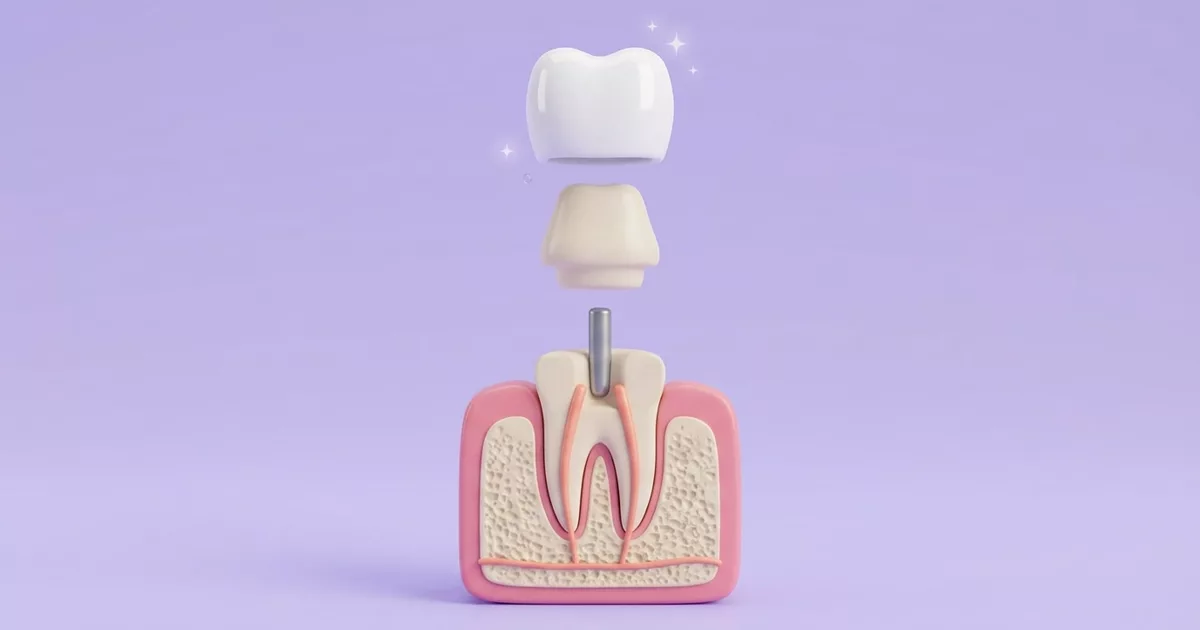
In almost every case, yes: after a root canal the tooth needs a restoration that protects it, and most of the time that restoration is a crown. The root canal removes the infection and saves the root, but it leaves the tooth more brittle — chew on it unprotected and it can crack. The usual sequence is root canal, then a core buildup or a post to rebuild the inside, and finally the crown, at a separate appointment.
Why a root canal tooth becomes fragile
A tooth that needs a root canal has usually already lost part of its structure to a large cavity, a crack or old fillings. During treatment, an opening is made to clean the canals, which removes a bit more tooth.
What’s left is a tooth with fewer walls and a hollow center. It can look fine and feel fine, but it no longer handles chewing forces the way it used to — especially a molar. That’s why our root canal aftercare instructions say don’t bite hard on that tooth until it has its final restoration.
Step 1: rebuilding the inside (core or post)
Before the crown, the tooth needs a solid foundation.
- Composite core buildup. A resin filling that rebuilds the missing part of the tooth and serves as the base for the crown. It’s the most common option when a good amount of healthy tooth remains. See our core buildup care guide.
- Post. When little tooth is left, a post is placed inside one of the treated canals to anchor the buildup. A post doesn’t strengthen the root by itself — its job is to hold the reconstruction in place. See our dental post care guide.
Which one you need depends on how much healthy tooth is left, and the doctor decides that at your exam. It isn’t a choice made on price.
Step 2: the final restoration
| Option | When it’s used | Keep in mind |
|---|---|---|
| Metal-free crown | Front teeth and molars; when appearance matters | Looks more natural, no dark line at the gum |
| Porcelain-fused-to-metal crown | Very common on molars | Strong; over the years a dark line can show at the gum |
| Onlay | When the tooth keeps most of its walls | Protects the weak area with less drilling; not for badly broken teeth |
| Long-term provisional crown (PMMA) | While the final crown is planned, or between trips | Protects better than a temporary filling, but it isn’t the final solution |
Prices for each option are in the Quick facts above and on our price list, including the total for a whole tooth (root canal, buildup and crown).
How long to wait between the root canal and the crown
There’s no single number for everyone. Some teeth are rebuilt soon; others are better watched for a few days, especially if there was a lot of infection or pain. The doctor decides based on how the tooth is healing.
What’s the same for everyone: the crown is another appointment. We don’t promise a root canal and a crown on the same day. If you’re coming from Calexico, El Centro or elsewhere in the Imperial Valley, plan at least two visits and ask us at your exam how to space them. In between, protect the tooth:
- Don’t chew hard foods on that side.
- If the temporary filling falls out or feels hollow, let us know — see our temporary filling guide.
- Don’t let weeks go by “because it doesn’t hurt anymore.” No pain doesn’t mean protected.
What happens if you skip the crown?
It’s one of the most common questions, and the honest answer is that you put the treatment you already paid for at risk:
- Fracture. A weakened tooth can split when you bite. If the crack reaches the root, the tooth often can’t be saved and has to be extracted.
- Leakage. A temporary filling wears down. If saliva and bacteria get back into the canal, the infection can return and the tooth may need retreatment.
- Higher cost later. Fixing a fracture or redoing a root canal usually costs more than restoring the tooth on time. Lose the tooth, and replacing it with an implant is a whole new treatment.
In some cases — mainly front teeth that take little chewing force — the doctor may consider a smaller restoration. But that’s decided by examining the tooth, not in advance.
Caring for a crowned tooth so it lasts
A root canal tooth with a well-made crown can serve you for many years, but it’s still a tooth: the root and the gum around it need the same care as the rest.
- Brush and clean between your teeth every day, paying attention to the line where the crown meets the gum. That’s where new decay can start.
- Check-ups every 6 months. We check how the crown fits and, when the doctor considers it necessary, take an X-ray of the root. If you have a dentist back home, they can do these check-ups too.
- Wear a night guard if you clench or grind, since grinding can chip porcelain or crack the tooth underneath.
- Let us know if the crown feels loose, comes off or hurts when you bite. Re-cementing it early is simple; leaving it loose lets bacteria leak in.
Without a nerve, the tooth no longer warns you with sensitivity when something starts to go wrong, so check-ups matter more than they do for a living tooth.
At our office in Mexicali
Root canals at our office are done by Dr. Gabriel Jiménez, the endodontist on our team, in 90-minute appointments. Dr. Jesara López then does the buildup and the crown and coordinates the whole plan, so you don’t have to go somewhere else to finish.
After your exam you get a written plan by WhatsApp listing each step and its cost — root canal, core or post, and crown — so you know the total before anything starts. You can pay in U.S. dollars, cash or card, and our front desk answers WhatsApp in English. We’re about 3 miles from the Calexico West crossing and open Saturdays. After each step, the matching aftercare guide is sent to your phone: root canal aftercare and dental crown care.
Still deciding whether to save the tooth? Read root canal or extraction? or see how we handle a root canal in Mexicali.
Frequently asked questions
Can I get the root canal in Mexicali and the crown back home in the US?
You can, but plan it so the tooth isn't left with a temporary filling for weeks. Ask for a written summary and X-rays to take with you. Most patients prefer to finish here so one team is responsible for the whole tooth.
Do I always need a post?
No. A post is only placed when little tooth structure is left and the crown needs more anchorage. If enough tooth remains, a composite core buildup is enough. The doctor decides after seeing how much healthy tooth is left.
Can the crown be done in the same trip as the root canal?
We don't promise that. The crown is a separate appointment, and some teeth are better observed for a few days first. If time is tight, a long-term provisional crown (PMMA, $2,800 MXN (≈ USD 170)) protects the tooth between trips.
Can an onlay replace a full crown?
Sometimes. If the tooth still has most of its walls, an onlay ($7,500 MXN (≈ USD 455)) can cover and protect the weak area with less drilling. If the tooth is badly broken down, a crown is usually the right call.
My root canal was done elsewhere. Can you place the crown?
Yes. Bring your X-rays or treatment summary if you have them. Dr. Jesara checks the tooth and the seal before rebuilding it; if something doesn't look right, we explain it before making the crown.