
Root Canal or Extraction? When It Pays to Save the Tooth
Saving a tooth with a root canal vs. pulling it: what each path involves, what happens if you leave the gap, and when extraction plus an implant makes sense.
Written by the team of Dr. Jesara López · Dental Surgeon (UABC) · Mexicali, B.C.
Updated:
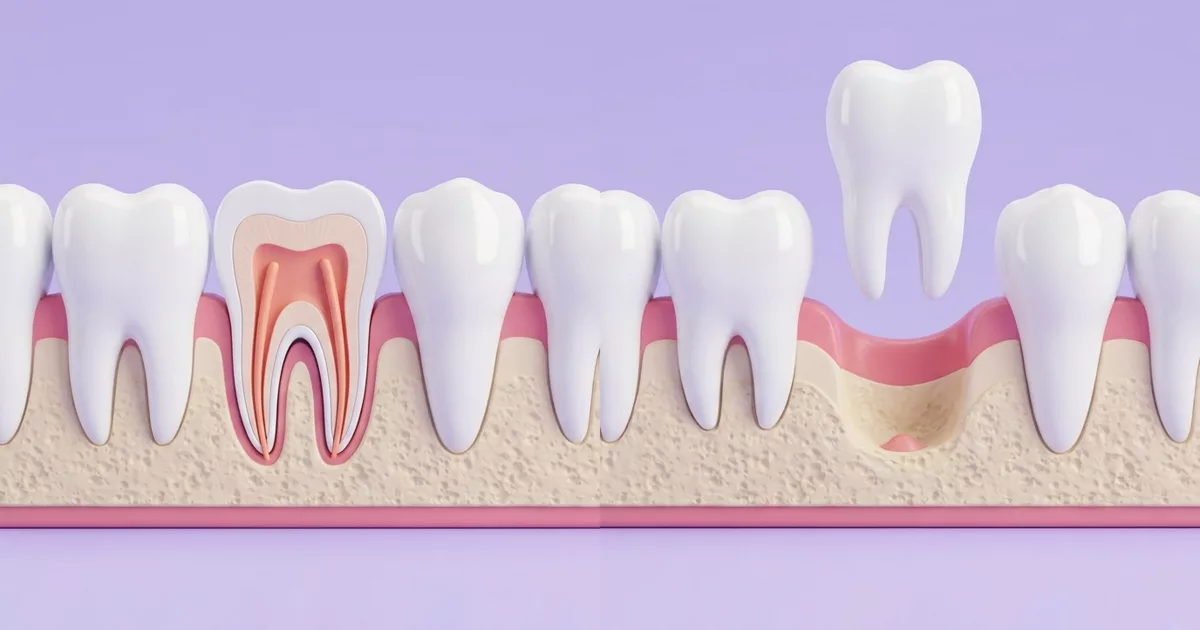
If you have been told a tooth needs a root canal — or that it “has to come out” — it is usually worth trying to save the tooth. A root canal plus a crown lets you keep your own tooth, with no surgery and no months of waiting. Pulling it is faster and cheaper that day, but it leaves a gap that slowly shifts the teeth around it, and replacing it later means an implant or a bridge. Extraction makes sense when the tooth is cracked down into the root, when there is not enough tooth left to rebuild, or when the bone no longer holds it; the doctor decides that at your exam.
What each option actually does
A root canal cleans out the inside of the tooth, where the infected or inflamed nerve is, and seals the canals. The tooth stays in place with its own root and bone. Afterward it needs a core or post and, in most cases, a crown so it does not fracture.
An extraction removes the whole tooth. It ends the pain and infection from that tooth in one visit, but leaves a space you can leave open or fill with an implant, a bridge or a partial denture.
The three paths side by side
| Root canal + crown | Extraction + implant | Extraction, no replacement | |
|---|---|---|---|
| Keep your own tooth? | Yes | No; replaced with an artificial one | No |
| Surgery? | No | Yes, to place the implant | Only the extraction |
| Time until normal chewing | A few weeks: 1 or 2 root canal visits, then the crown | 3 to 6 months until the final crown | However long the gum takes to heal |
| Neighboring teeth | Left alone | Left alone | Tilt into the gap over time |
| Jawbone in that spot | Preserved, because the root stays | The implant helps preserve it | Gradually shrinks |
| Cost | Root canal + core or post + crown | Extraction + implant + crown | Just the extraction, on the day |
Prices for each path are in the Quick facts above and on our price list.
When saving the tooth makes sense
- There is enough healthy tooth above the gum to hold a crown.
- The root is intact, with no vertical crack.
- The gums and bone around it are reasonably healthy.
- It is a tooth you chew with or that shows when you smile.
In those cases a root canal is usually the most conservative choice: you keep your tooth and skip surgery. A well-restored natural tooth can last many years with good care and regular check-ups.
When extraction makes sense
- The tooth is cracked down into the root or split lengthwise.
- Decay has destroyed so much that there is nothing left to anchor a crown.
- Gum disease has loosened the tooth and the bone no longer supports it.
- The tooth has no real function (some wisdom teeth, for example) and saving it adds nothing.
If the tooth does come out, it is best to plan the replacement from day one. We cover that in when do you need a dental implant and compare the options in implant vs. bridge vs. denture.
What happens if you pull it and leave the gap?
At first, nothing seems to change. Over the following months:
- The teeth next to the gap tilt into the space, and the opposite tooth can drift up or down because it has nothing to bite against.
- New gaps open where food gets trapped, which makes cavities and gum problems more likely.
- The bone in that area shrinks, so if you want an implant later you may need a bone graft.
- You end up chewing mostly on one side.
It is not an emergency, but it is a decision worth making on purpose rather than by default.
What about just taking painkillers?
Painkillers calm the symptom, but they do not remove the infection inside the tooth. The pain can come and go, and the infection can keep spreading toward the bone even during the weeks it stops hurting. Waiting often changes the plan: a tooth that could be saved today may end up as an extraction. If you have pain or swelling, get it checked soon — we describe what to expect in does a root canal hurt?.
If a previous root canal has failed
A tooth that already had a root canal and starts bothering you again does not automatically need to come out. Sometimes a retreatment is possible: the old filling material is removed, the canals are cleaned again and resealed. If the tooth has a post, it may need to be removed first. More in failed root canal: retreatment.
Questions that help you decide
- Does the doctor see enough tooth to rebuild? If so, saving it is usually the conservative choice.
- Is it a tooth you chew with, or one that shows? The more it does, the more it is worth keeping.
- If it comes out, will you replace it? Compare the total cost of extracting and replacing with the cost of saving it — not just what you pay that day.
- How many trips can you make? A root canal and crown take separate visits; an implant takes months. Leaving the gap is fastest, with the trade-offs above.
At our office in Mexicali
- Root canals are done by Dr. Gabriel Jiménez, the endodontist on our team, in 90-minute appointments. In 2026 our root canal patients needed 1.6 visits on average; the crown is a separate visit, so plan your trips with that in mind.
- Dr. Jesara López does your exam, coordinates the plan and handles the restoration: core, post and crown.
- If the tooth has to come out, our oral surgeons and implant specialist work in the same office — the recommendation does not depend on sending you somewhere else.
- You get a written plan on WhatsApp with the cost of each option before anything is done. You can pay in US dollars, cash or card. We are about 3 miles from the downtown Calexico crossing, and we see patients on Saturdays too.
- After treatment, your aftercare guide arrives on WhatsApp: root canal aftercare or tooth extraction aftercare.
See how we work on our root canal in Mexicali page, or read what the tooth needs next in do you need a crown after a root canal?.
Frequently asked questions
My US dentist said the tooth has to come out. Can you give me a second opinion?
Yes. Send your X-rays by WhatsApp or bring them to your exam. The doctor checks whether the tooth can be saved with a root canal or really needs to come out, and you get a written plan with both options when both apply.
Isn't pulling the tooth cheaper?
On the day, yes: an extraction is from $1,500 MXN (≈ USD 91). But if you later want to replace the tooth, an implant with a crown is from USD 1,300 per tooth, compared with ≈ $9,700–$12,200 MXN (≈ USD 590–740) to save it with a root canal, core or post and crown.
Can I do the root canal on one trip and the crown on another?
Yes — the crown is always a separate visit. In between, the tooth has a temporary filling and you should avoid biting hard on it, because a root-canal-treated tooth is more fragile until it gets its final restoration.
I already had a root canal in the US and it hurts again. Does it have to come out?
Not necessarily. A root canal retreatment ($4,000 MXN (≈ USD 242)) redoes the canals when the first treatment failed, wherever it was done. The doctor decides at your exam whether it is a good option for your tooth.