
Failed Root Canal? Signs, Retreatment and When Extraction Makes More Sense
Signs a root canal you had before has failed, what retreatment involves, when a post has to come out and when pulling the tooth makes more sense.
Written by the team of Dr. Jesara López · Dental Surgeon (UABC) · Mexicali, B.C.
Updated:
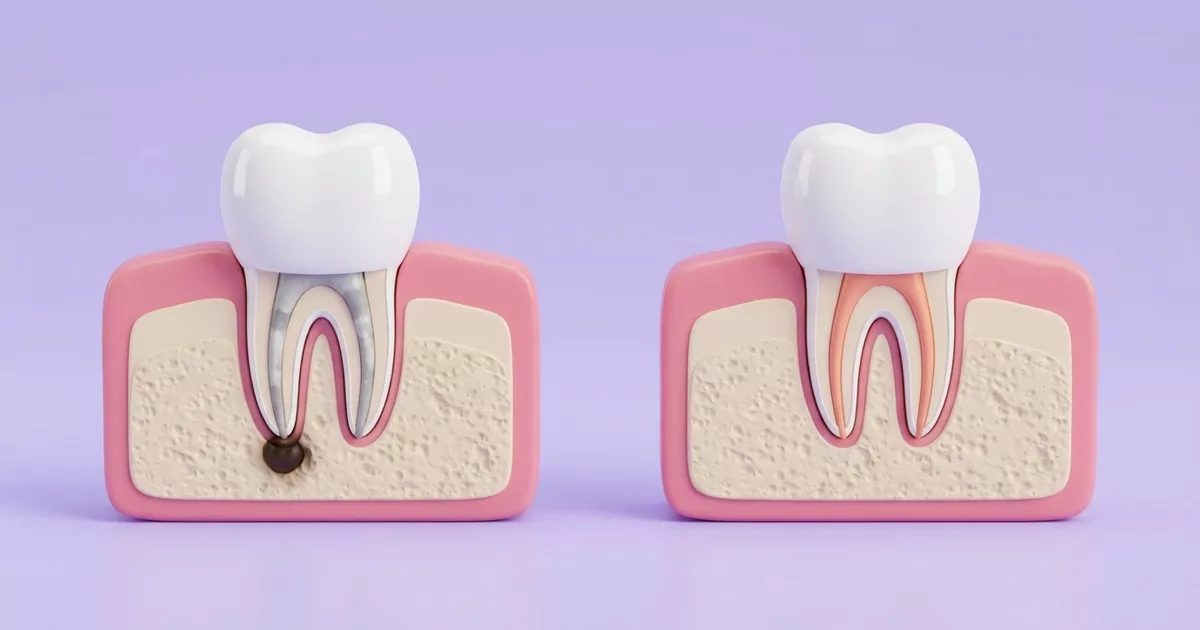
A root canal can fail months or years after it was done, most often because a canal was missed, the filling or crown on top started leaking, or the tooth cracked. The usual signs are biting pain that comes back, swelling, or a small bump on the gum near that tooth. In many cases the tooth can still be saved with root canal retreatment: the tooth is reopened, the old filling material is removed, and the canals are cleaned and sealed again. If the root is cracked or there isn’t enough tooth left, the honest answer is to look at extraction.
Signs a root canal isn’t working
It’s normal for a tooth to feel sore when you bite for a few days after a root canal, and that soreness should get better every day. What is not normal:
- The pain gets worse after day 2 or 3 instead of better.
- A tooth that had a root canal years ago starts hurting again, especially when you bite or touch it.
- Your gum or face swells near that tooth.
- A pimple-like bump shows up on the gum and sometimes drains or tastes bad. That’s a fistula: the infection is looking for a way out.
- The crown or filling on top fell off, broke, or has an open edge.
- A follow-up X-ray shows a lesion at the tip of the root.
Sometimes a failed root canal doesn’t hurt at all and only shows up on an X-ray, so an old root canal tooth should be part of your regular check-up.
Why root canals fail
It isn’t always the first dentist’s fault. The most common reasons:
- A canal that was missed or not fully cleaned. Some teeth have extra, curved or very narrow canals.
- Leakage from the top. If the permanent crown or filling took too long or came loose, saliva and bacteria get back into the canal.
- New decay under the restoration.
- A cracked tooth or root. A tooth with a root canal is more brittle. Without its final restoration, usually a crown, it can split when you bite.
That last one matters most: a crack in the root almost never gets fixed by retreatment.
What retreatment involves
At our office it is done by Dr. Gabriel Jiménez, the endodontist on our team, in an appointment of about 90 minutes under local anesthesia. In broad steps:
- An X-ray to see what was done and what went wrong.
- The tooth is opened, through the crown or by removing it if needed.
- The material used to fill the canals the first time is taken out.
- The doctor looks for canals that were left untreated, then cleans and disinfects them.
- The canals are sealed again and the tooth is closed with a temporary filling.
Afterward, just like after the first root canal, the tooth needs its final restoration so it doesn’t crack: a core or post and, in most cases, a crown. Dr. Jesara López plans and does that part.
If the tooth has a post
If a post was placed inside the root after the first root canal, it has to come out before the canal can be treated again. Post removal is a separate procedure, in an appointment of about 120 minutes. A post can’t always be removed without putting the root at risk; if the risk of cracking it is high, the doctor tells you before starting and other options are considered.
When retreatment isn’t worth it
Retreatment is about keeping your natural tooth, but it isn’t right for every case. Extraction is considered when:
- The root is cracked or fractured.
- So little healthy tooth is left that there’s nothing to hold a crown.
- Decay has reached below the gum down to the bone.
- Removing the post would very likely break the root.
Then we go over your options to replace the tooth: an implant, a bridge or a removable partial denture. To compare, read root canal or extraction? and what a dental implant costs in Mexicali. If the tooth comes out, you get our tooth extraction aftercare guide in English.
Nothing is done without your OK: after the exam you get a written treatment plan as a PDF by WhatsApp, with the cost of each step.
If you’re back home in the U.S.
Root canal trouble doesn’t always wait for your next trip. If a tooth we treated, or one treated anywhere else, starts hurting after you’re back in Calexico, El Centro or Yuma:
- Message us on WhatsApp at +52 686 203 1211 with a photo and a short description. Our front desk answers in English, and it’s the same number from the U.S.
- Avoid chewing on that side, and take any medication you were prescribed exactly as directed, finishing the full course of antibiotics.
- If the crown came off, keep it and bring it. Don’t glue it back yourself.
- If your face swells quickly, you run a fever, or it’s hard to open your mouth or swallow, get seen the same day, wherever is closest.
Antibiotics can calm swelling for a few days, but they don’t clean the canal. If the cause is still there, the infection comes back.
At our office in Mexicali
Retreatment, post removal and the final restoration are all done in the same office: the endodontist treats the canals and Dr. Jesara handles the rebuild and the crown. We’re about 3 miles from the Calexico West crossing, open Monday to Friday 10 a.m. to 8 p.m. and Saturday 9 a.m. to 3 p.m., Pacific Time. If the schedule allows, we can see you the same day. You can pay in U.S. dollars, cash or card, or in pesos.
After treatment you get our root canal aftercare guide and, if you have a post, our dental post aftercare guide, both in English by WhatsApp. List prices are on our price list. See the full treatment on root canals in Mexicali.
Frequently asked questions
Can you retreat a root canal that was done in the U.S.?
Yes. We treat teeth no matter where the first root canal was done. If you have the X-rays or records from your U.S. dentist, send them by WhatsApp before you come.
How long after a root canal can it fail?
It can cause trouble within weeks or show up years later, for example when the filling or crown on top leaks or the tooth cracks. New pain in an old root canal tooth is worth an exam.
Is retreatment more painful than the first root canal?
It is done under local anesthesia, like the first one. It takes more work because the old filling material has to come out, but you shouldn't feel pain during the appointment; the tooth may be sore to bite on for a few days.
My dentist at home says the tooth has to come out. Can you check it?
Yes. At the exam we tell you honestly whether retreatment is reasonable or extraction is the better call, and you get the plan and costs in writing to compare.
Will I need a new crown after retreatment?
It depends on the crown you have. If it had to be removed or it was leaking, a new restoration goes on; if it still fits well, it can sometimes be kept. The doctor decides after checking the tooth.