
Signs You Need a Root Canal — and When It's an Emergency
Pain that wakes you up, sensitivity that lingers, pain when biting, a swollen gum or a darkening tooth: what they can mean and when to see a dentist right away.
Written by the team of Dr. Jesara López · Dental Surgeon (UABC) · Mexicali, B.C.
Updated:
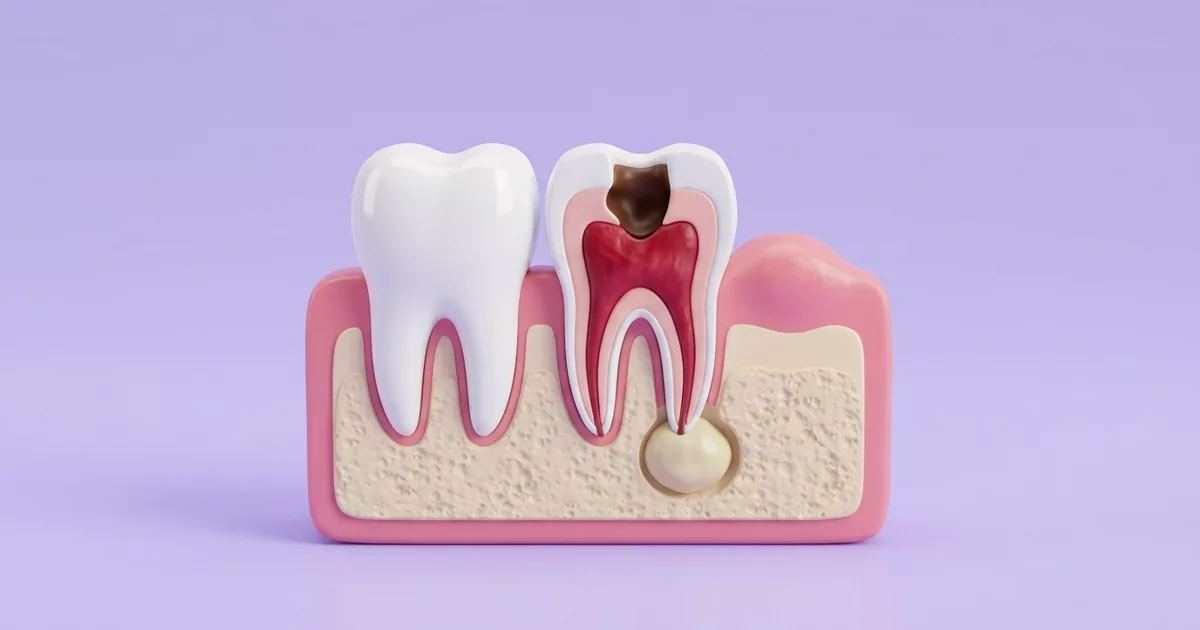
The most common signs that a tooth may need a root canal are pain that starts on its own (even at night), hot or cold sensitivity that lingers long after the stimulus is gone, pain when you bite, and a swollen gum or a small “pimple” near the tooth. No single sign confirms it: only a dental exam, usually with an X-ray, tells whether the nerve can be protected or a root canal is needed.
What’s happening inside the tooth
Inside every tooth is soft tissue with nerves and blood vessels — the pulp. When deep decay, a crack or an injury reaches it, the pulp becomes inflamed or infected. Early inflammation can settle down; if it progresses, the damage can’t be reversed and the pulp eventually dies.
A root canal removes that damaged pulp, cleans and disinfects the canals and seals them, so you keep the tooth instead of losing it.
The signs, one by one
1. Spontaneous pain, or pain that wakes you up
Pain that shows up without eating or touching the tooth, that throbs, or that wakes you at night is one of the clearest signs the pulp is badly inflamed. If over-the-counter painkillers barely touch it, don’t wait.
2. Sensitivity that lingers
Feeling something with an ice-cold drink is normal. What’s concerning is when the ache lasts several seconds or minutes after the cold or heat is gone, or when heat hurts and cold brings relief. Brief sensitivity is usually something else — gum recession or worn enamel — and is treated differently.
3. Pain when biting or touching the tooth
If it hurts to chew, clench or even press the tooth with your tongue, the inflammation may have reached the tissue around the root. It can also be a cracked tooth, which the exam will show.
4. A swollen gum or a “pimple” that comes and goes
A small bump on the gum near the tooth, sometimes with pus or a bad taste, is usually a fistula — a drainage path the infection has opened. If it stops hurting once it drains, that doesn’t mean it healed.
5. A tooth that turns darker
A tooth that turns grayish or darker than its neighbors, especially after an injury, can have a damaged pulp even without pain.
6. Facial or gum swelling
Swelling in the face or neck, especially with a fever, means an infection is spreading. That is urgent.
What can’t be known without an exam
These signs also show up with other problems: gum inflammation, a high filling, a crack, a wisdom tooth. That’s why we don’t recommend deciding by symptoms. At the exam the dentist checks the tooth, runs simple tests and usually takes an X-ray to see the root and the bone around it.
That leads to one of three paths:
| Situation | What’s usually done |
|---|---|
| Decay is close to the nerve but the pulp is healthy | Pulp capping and a filling — the nerve is protected and a root canal is avoided |
| The pulp is badly inflamed or infected and the tooth can be rebuilt | Root canal, then a core or post and a crown |
| The tooth is too broken down or cracked into the root | Extraction is considered, along with how to replace it |
If you’re between the last two, read root canal or extraction?.
What if I just take pills?
Painkillers and antibiotics can ease pain or swelling for a while, but they don’t remove the damaged pulp or the infection inside the canal. Most often the problem comes back, sometimes as a bigger abscess.
Taking antibiotics on your own isn’t a good idea either: if you don’t need them, they don’t help, and if you do, a dentist should prescribe the right dose and number of days. Until your appointment, take the painkiller you normally use as directed on the label and avoid chewing on that side.
When it’s an emergency
Get care the same day if you have:
- Swelling of the face, eye or neck.
- A fever along with tooth pain.
- Trouble swallowing, opening your mouth or breathing (in that case, go to the nearest emergency room, on either side of the border).
- Severe pain that painkillers don’t control.
Infection-related swelling doesn’t always rule out treating the tooth that day, but sometimes it has to be brought under control first. The doctor decides at your exam.
How to avoid needing a root canal
Many root canals start as a small cavity that didn’t hurt. Treated early, that usually means a simple filling instead of a root canal:
- Check-ups every 6 months, even without symptoms. Decay caught early rarely reaches the nerve.
- Don’t ignore new sensitivity that keeps coming back in the same tooth. It’s easier to protect the nerve while it’s still healthy.
- Have old fillings checked. A worn filling can let decay spread underneath without you noticing.
- Wear a mouthguard for contact sports and a night guard if you clench: injuries and cracks also damage the pulp.
- If you chip or break a tooth, come in soon even if it doesn’t hurt; an open fracture lets bacteria travel toward the nerve.
And if a dentist recommends a root canal on a tooth that doesn’t hurt, ask what they saw at the exam. Many patients cross the border for a second opinion, and you deserve to understand the reason before approving a plan.
At our office in Mexicali
Your exam is done by Dr. Jesara López or a specialist on our team, and root canals are done by Dr. Gabriel Jiménez, our endodontist, in 90-minute appointments. If there’s room in the schedule we can see you the same day — message us on WhatsApp in English and tell us what you’re feeling. We’re about 3 miles from the Calexico West crossing and open Saturdays, which helps if you work during the week in the Imperial Valley.
Before any treatment you get a written plan by WhatsApp with the cost of each step, and nothing is done without your approval. You can pay in U.S. dollars, cash or card. If you need a root canal, we send you our pre-anesthesia instructions beforehand and our root canal aftercare guide afterward.
Nervous about the procedure? Read does a root canal hurt? or see how we handle a root canal in Mexicali.
Frequently asked questions
Can a tooth need a root canal even if it doesn't hurt?
Yes. Sometimes the nerve dies slowly without pain, and the only warning is a tooth turning darker or a small bump on the gum. That's why regular check-ups matter even when nothing hurts.
My tooth hurt badly and then suddenly stopped. Is it healed?
Not necessarily. When the nerve dies, the pain can go away while the infection stays. If you had severe pain that stopped on its own, get it checked before an abscess forms.
Can I be seen the same day if I cross from Calexico with a toothache?
If there's room in the schedule, yes. Message us on WhatsApp — same number from the US, and our front desk answers in English — tell us what you feel and since when, and we'll give you the first available time.
What is pulp capping?
A treatment that protects the nerve when decay is close but the nerve is still healthy. A protective material is placed and the tooth is restored. When it works, it avoids a root canal; it costs $2,500 MXN (≈ USD 152).
How much is an exam to find out if I need a root canal?
A general exam is $500 MXN (≈ USD 30) and a specialist exam is $800 MXN (≈ USD 48). We check the tooth and send you a written plan with the cost of each treatment. You can pay in U.S. dollars.