
Simple vs. Surgical Tooth Extraction: What's the Difference?
How a simple extraction differs from a surgical one, when surgery is needed, who does it, how long the visit takes and how each one is quoted in Mexicali.
Written by the team of Dr. Jesara López · Dental Surgeon (UABC) · Mexicali, B.C.
Updated:
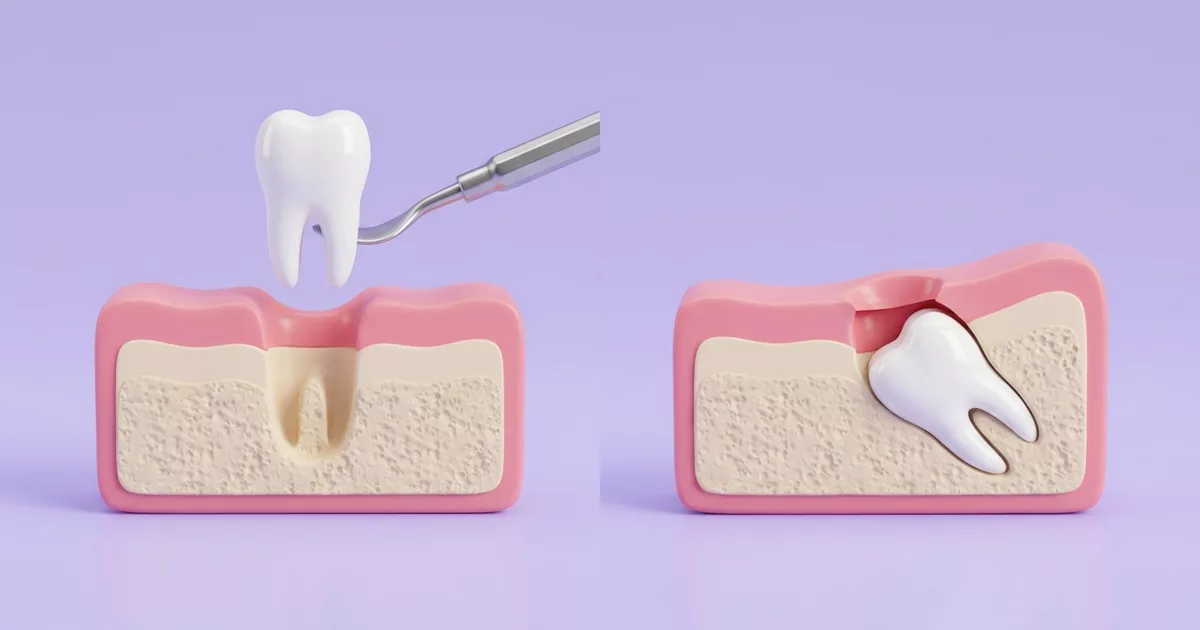
A simple extraction is when the tooth is fully visible and comes out in one piece with instruments, without opening the gum. A surgical extraction is needed when the tooth is trapped in the bone, badly broken down, has a fractured root or sits in a difficult position: the surgeon opens the gum, sometimes removes a little bone or divides the tooth into pieces, and usually closes with stitches. Both are done with local anesthesia and almost always in a single visit. Which one you need is decided at your exam.
Side by side
| Simple extraction | Surgical extraction | |
|---|---|---|
| Is the tooth visible? | Yes, fully erupted | Not always: impacted or partly erupted |
| Is the gum opened? | No | Yes |
| Is the tooth divided? | No | Sometimes, to remove it in pieces |
| Stitches | Usually not | Common |
| Recovery | Shorter | More swelling the first few days |
| How it’s priced | From the listed price | In writing, after your exam |
When an extraction is surgical
- Impacted wisdom teeth or ones that are only partly out — see when to remove wisdom teeth.
- Long, curved or spread-out roots that won’t come out with a simple movement.
- A tooth badly broken down by decay that crumbles when it’s moved.
- A root left behind from an earlier extraction or a fracture.
- A root-canal-treated tooth that became brittle and can no longer be saved.
What happens at the appointment
- Exam and explanation. The doctor checks the tooth, tells you which type of extraction it is and what to expect.
- Local anesthesia. The area is numbed. You’ll feel pressure and movement, but it shouldn’t hurt; if it does, say so and more anesthetic is given.
- The extraction. In a simple one, the tooth is loosened and removed. In a surgical one, the gum is opened, the tooth is freed and, if needed, divided into pieces.
- Closing. The area is cleaned and, for surgical cases, stitched. You bite on gauze with firm pressure.
- Instructions. You get your aftercare explained, and the tooth extraction aftercare guide arrives on WhatsApp in English.
Before your visit
- Read the pre-anesthesia instructions.
- Don’t come on an empty stomach with local anesthesia: eat something light 2–3 hours before.
- Tell us about your medications, especially blood thinners like aspirin or warfarin, and conditions such as diabetes. Don’t stop anything unless your doctor tells you to.
- Skip alcohol for 24–48 hours before and tobacco for 12 hours before.
- With simple local anesthesia you can come alone and drive yourself back — useful when you’re crossing on your own.
- Arrive 10–15 minutes early and let us know if you have a cold, cough or fever.
Recovery depends on the type
With both, the first days bring normal soreness that eases day by day. Surgical extractions usually mean more swelling: according to our guide, it increases on days 1 and 2, peaks around days 3 and 4, then starts going down. What helps:
- Cold on the cheek, 20 minutes on and 20 off, on the first day.
- Head raised when you sleep.
- No spitting, no straws and no vigorous rinsing, to protect the clot.
- Soft, cool or lukewarm food; nothing hot, hard or spicy.
- No smoking for at least 5 days.
Let us know if bleeding doesn’t stop after an hour of pressure, you have a fever over 38 °C (100.4 °F) or the pain gets worse after day 2 or 3. Intense pain on days 2 to 4 may be dry socket. To plan work or school, see time off after a tooth extraction.
Questions to ask at your exam
- Is mine simple or surgical, and why? That tells you what recovery to expect.
- Will I get stitches? And if so, whether they dissolve or need a return visit to remove — important when every visit means a border crossing.
- How many days of soreness should I plan for? So you can arrange work, school or exercise.
- Should I replace the tooth? If yes, ask whether anything is done at the extraction to protect the bone.
- Which pain medication, and when do I start it? Our guide says to start the painkiller before the anesthesia wears off, and to avoid aspirin because it makes clotting harder.
All of it goes into your written plan and the aftercare guide we send on WhatsApp, so you don’t have to remember it in the car.
Extractions for children
For kids, extractions are done by the pediatric dentists on our team in 60-minute appointments, with a dedicated child tooth extraction aftercare guide.
If you plan to replace the tooth
If the tooth will be replaced with an implant, mention it before the extraction: sometimes socket preservation is done at the same time to protect the bone where the tooth was. We go over replacement options in replacing a tooth after an extraction, and if you’re still weighing saving it versus pulling it, see root canal or extraction?.
At our office in Mexicali
- Our team includes 5 oral surgeons: Dr. Sergio Villafan, Dr. Rafael Robles, Dr. Marco Romero, Dr. Óscar Hernández and Dr. Jesús Anguiano. In 2026 they did 3 out of 4 extractions; simpler ones are also done by Dr. Jesara López and our general dentists.
- Extraction and surgery appointments are 60 minutes, and one visit is almost always enough (1.2 on average in 2026). In 2026, 37 % of our extraction appointments were for patients with a US phone number.
- You get a written plan on WhatsApp with the cost before we start. The reference price is on our price list.
- Pay in US dollars or pesos, cash or card. Our front desk answers in English on WhatsApp, and we’re open Monday to Saturday on Pacific time, about 3 miles from the downtown Calexico crossing.
Learn more on our tooth extraction in Mexicali page.
Frequently asked questions
How do I know if mine will be surgical?
The doctor tells you at your exam after looking at the tooth and its position. If it's impacted, badly broken down or has complicated roots, it will most likely be surgical.
Why isn't the surgical extraction price listed?
Because it varies a lot with the tooth's position and what has to be done. We publish the starting price of a simple extraction ($1,500 MXN (≈ USD 91)); a surgical one is quoted in writing after your exam, before anything is done.
Will I need stitches?
They're common with surgical extractions. If you get stitches, the doctor tells you whether they dissolve on their own or need to be removed, and when — worth knowing before you plan a second trip.
Can I drive back across the border after an extraction?
With simple local anesthesia, yes — our pre-anesthesia guide says you can come alone and drive yourself back. Bring the gauze and your aftercare instructions for the wait in line.
Can you prepare the bone for an implant when you take the tooth out?
Yes, that's called socket preservation (USD 380) and it's done at the time of the extraction. It's best decided at your exam, before the tooth comes out.